That's where sales enablement comes in from a product management perspective.
Commercial Product Management equips sales with the product knowledge, arguments and materials they need to advise customers confidently and convincingly. This includes value propositions for different target audiences, pricing arguments, ROI calculations, product materials, training content and a structured process for bringing market feedback back to the team.
The term sales enablement, however, is used in different ways. In academic literature, it describes the cross-functional coordination of marketing, training, sales operations, management and automation to better support customers throughout their buying journey (Peterson and Dover 2020, Journal of Selling). This also includes onboarding, coaching, sales software and performance metrics. From a product management perspective, the key functions working together are MarCom, Sales and R&D.
This article focuses on the part owned by Commercial Product Management: the product-related content that sales teams use to sell.
| Sales enablement overall | Sales enablement through Commercial Product Management | |
|---|---|---|
| Focus | How the sales team operates and sells | What the sales team knows and communicates about the product |
| Typical elements | Onboarding, coaching, sales training, sales processes, CRM, software and performance metrics | Customer value, value propositions, sales arguments, pricing, ROI, product materials, training content, competitive intelligence and market feedback |
| Ownership | Sales leadership, Sales Operations, Learning & Development | Commercial Product Management |
What product management-led sales enablement includes
Sales enablement goes beyond a product presentation or technical data sheet. It starts with identifying which customer groups to target, including market segments and functional departments, and extends to explaining the specific value the product creates for those customers.
The responsibilities are clearly divided: Commercial Product Management develops the product-related content. Sales uses it in customer conversations and reports back on the questions, objections and requirements that come up in the market. The key components can be delivered through traditional and digital formats:
| Component | Traditional | Digital |
|---|---|---|
| Sales playbook | Guide covering target customers, conversation structure and key arguments | Up-to-date playbook in the intranet or CRM |
| From feature to value | Overview connecting product features, benefits and customer value | Value matrix as a CRM template |
| Sales arguments | Sales argumentation guide | Conversation guides and email templates |
| Pricing | Price overview | Centrally accessible price lists and terms |
| ROI | Customer ROI calculation | ROI calculator in a spreadsheet or online tool |
| Market feedback | Sales feedback shared with Product Management | Feedback board for collecting, tracking and evaluating input |
| Product materials | Catalogs, brochures and technical data sheets | Digital library containing the latest approved versions |
| Product videos | Product demonstrations and customer demos | Product videos, explainer videos and application videos |
| Training | Training materials incorporating questions and feedback from Sales | E-learning, short videos and webinars |
| Competition | Competitive analyses | Competitor comparisons and battlecards |
| Segmentation | Target customers, market segments and functional departments | Target account lists in the CRM |
| USP and value proposition | One-pager for each target audience | Shareable PDF one-pager |
| Customer references | User reports | Online case studies and customer testimonials |
I explain how to turn a product feature into a compelling customer value proposition in Why everyone in the company should speak the language of value. You can also find a free Product One-Pager template in the Downloads.
What sales enablement is not
Not just sales training
Product Management prepares the product-related content for training. Sales is responsible for how sales conversations are conducted. That's where Sales takes the lead.
Not a feature list
Technical specifications alone don't equip anyone to sell a product's value. Sales needs to understand which problem the product solves and why that solution matters to the customer.
Not complete control over sales activities
Product Management defines the market segments and functional departments to target. Sales decides which individual existing and prospective customers to select and prioritize, how to approach them and which channels to use. Product Management provides the product-related foundation and supporting materials.
Not a software tool
Software can make content easier to distribute and use, but it can't replace content that doesn't exist. Sales enablement can be organized as a dedicated department, which is often beneficial. Academic literature primarily describes it as an organizational capability rather than something tied to a specific department (Peterson and Dover 2020). Regardless of the structure, product-related content comes from Product Management.
What a lack of sales enablement costs a company
When Product Management doesn't adequately equip Sales, the consequences go far beyond individual customer conversations. They affect revenue, margins, selling costs and how quickly products succeed in the market.

Unnecessary discounts erode margins
When Sales can't explain a product's added value, price often becomes the only argument left in the negotiation. Instead of demonstrating the value compared with competing products, the sales rep offers a discount. That may help close the deal, but it reduces the margin.
Sales cycles get longer
When sales arguments, ROI calculations or current product materials are missing, information has to be provided later in the sales process. Sales waits for answers, Product Management handles the same individual requests repeatedly and customer decisions get delayed.
Sales performance becomes too dependent on individuals
Without consistent product messaging, every sales rep develops their own explanation. Experienced reps can often compensate for this. Less experienced colleagues have to build that knowledge themselves. The company becomes unnecessarily dependent on individual employees.
Product launches lose momentum
A product may be developed, approved and available while the sales team still lacks the right arguments to sell it. If target audiences, value propositions, pricing arguments and supporting materials aren't ready on time, Sales goes to market without the preparation it needs.
Valuable market feedback gets lost
Without a structured feedback process, customer questions, objections and competitive intelligence remain with individual sales reps. Product Management learns too late where the messaging falls short, what customers need or which information is missing.
For executive leadership, the question isn't simply whether a product sells. It's also how much margin, time and internal capacity the company loses because Sales isn't properly prepared.
The benefits of effective sales enablement
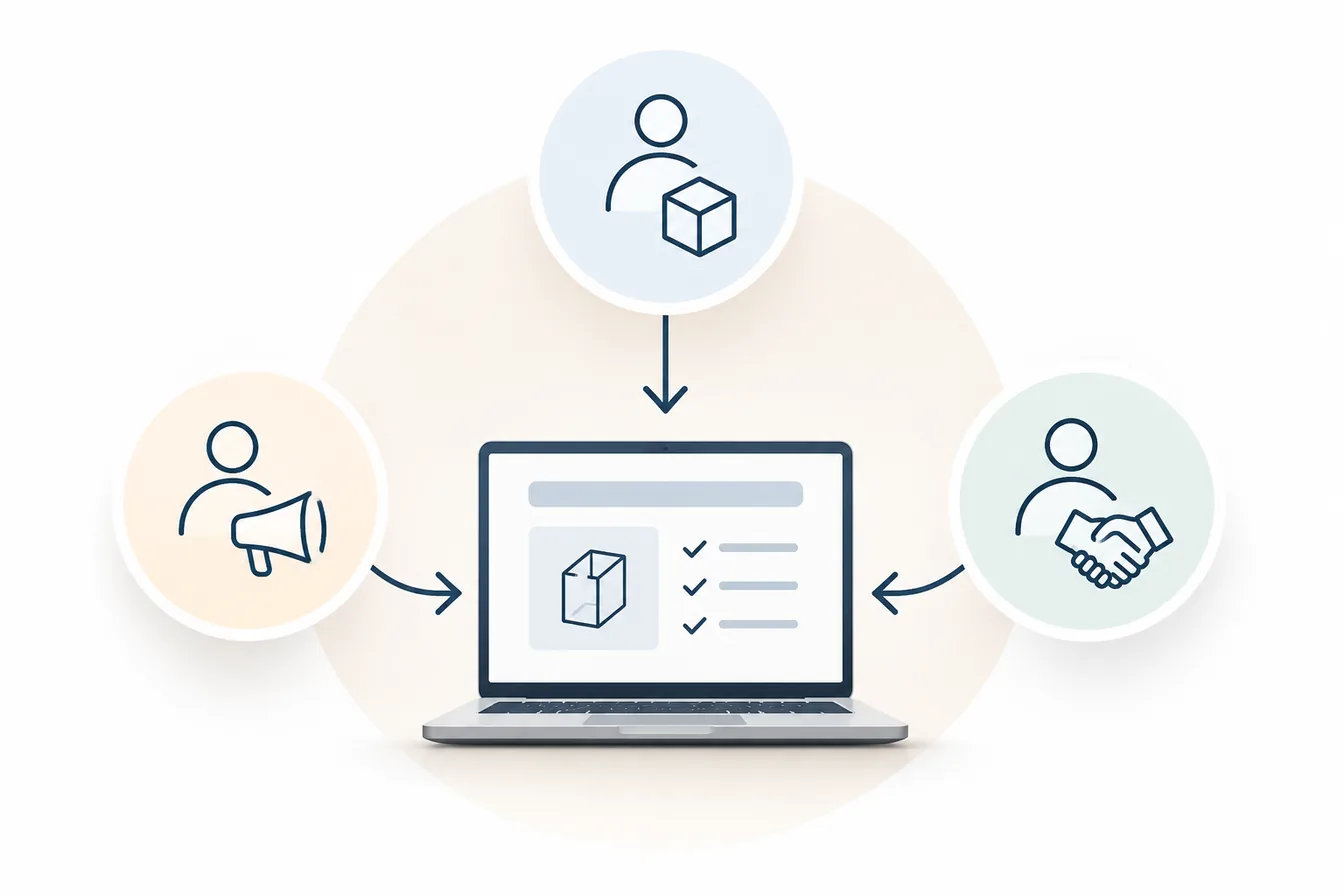
The biggest benefit comes from Product Management, MarCom and Sales working together. Everyone operates from the same foundation and communicates a consistent picture of the product.
- Sales reps approach customers with greater confidence because they understand the product and its value.
- Prices can be justified with clear arguments, including comparisons with competing products.
- Customers receive consistent information, regardless of whom they speak with in the company.
- Recurring questions don't have to be answered from scratch because arguments and materials are centrally available.
- Market feedback reaches Product Management through a structured process and can inform the product, its positioning and supporting materials.
Why sales enablement matters in every company
Whether it's a small business, a midsize company or a global corporation, sales enablement is one of the core responsibilities of a Commercial Product Manager. They know the product, the target audiences and the market. They understand which value matters to which customer. That puts them in a position to equip Sales with the product knowledge and arguments it needs.
This is particularly important because B2B products often require considerable explanation. Customers compare technical specifications, prices, applications and economic benefits. Sales therefore needs to do more than list product features. Without a clear value argument, the product is more likely to be compared primarily on price, especially when the customer benefit isn't immediately obvious from a data sheet.
Sales enablement ensures that this knowledge isn't limited to the Product Manager or a handful of experienced sales reps. It becomes available to the entire sales team.
How to recognize when sales enablement is missing
The warning signs usually show up directly in Sales:
- Sales reps openly say they don't feel confident discussing the product.
- The sales team struggles to sell the product convincingly.
- Prices can't be justified through customer value or comparisons with competing products.
- Sales relies primarily on discounts rather than the product's value.
- Sales conversations focus mainly on features instead of customer value.
- The messaging fails to connect with customers and end users on an emotional level.
I cover three additional warning signs in Why B2B companies leave their best weapon on the shelf and how sales enablement changes that.
Who owns what: Product Management, MarCom or Sales?
Responsibilities can become particularly unclear when Product Management sits within the Marketing organization. What matters isn't just the organizational chart, but who has functional responsibility.
Performance Marketing
This team also needs product-related information from the Product Manager so campaigns communicate the right customer value.
MarCom (Marketing Communications)
Product Management provides the content, develops the brief and explains the positioning. MarCom translates that foundation into marketing communications.
Product Management Commercial PM
Commercial Product Management owns the product-related content. This requires commercial understanding as well as product knowledge. A purely technical Product Manager doesn't necessarily bring that experience. In my experience, technical Product Managers have often been too far removed from the commercial side, talking almost exclusively about features rather than customer value.
Where Product Management sits varies considerably by country, company and business size. In some organizations, Product Managers belong to Global Marketing or Global Marketing Strategy. In Germany, they often sit within Brand Management. That can work. But particular care is needed: Product Managers working strategically in upstream marketing must neither be placed in the wrong department nor become too disconnected from the rest of the organization. Otherwise, they lose touch with Sales, R&D and the market, the very functions they need to support and learn from.
Sales, in turn, is responsible for how these materials are used in customer conversations. I explain why Product Management prepares Sales but doesn't replace it in Why a product manager isn't a substitute for Sales.
Common mistakes companies make
One mistake comes up repeatedly: MarCom takes ownership of the content in brochures, catalogs and sales materials. It's understandable because MarCom designs these materials. But responsibility for the content belongs to the Product Manager.
The Product Manager defines which value should be emphasized for each target audience and how the product should be presented. In my experience, most MarCom employees haven't been trained in value-based communication or sales enablement. That's not a criticism of them. It's simply not their responsibility.
It becomes even more difficult when sales enablement is assigned to career changers with no experience in Product Management or Sales. In that case, both product knowledge and commercial understanding are missing. Under those conditions, sales enablement is bound to fail, regardless of how committed the person may be.
The most common mistakes at a glance:
- MarCom determines the content of sales materials instead of Product Management.
- Sales enablement is assigned to career changers without product management or sales experience.
- A purely technical Product Manager is expected to equip Sales commercially.
- Sales materials are developed only after launch instead of before.
- There is no established process for bringing sales feedback back to Product Management.
Sales enablement isn't about giving Sales as many materials as possible. It's about providing the knowledge and arguments needed to sell a product's value convincingly. If Product Management fails to build that foundation, Sales has to fill the gaps itself. That costs time, makes sales performance dependent on individuals and can erode margins.
A good product needs more than a sales team that can sell it. It needs a sales team that can explain its value.
Source: Peterson, R. M. and Dover, H. F. (2020): Sales Enablement: Definition, Domain, and Future Considerations, Journal of Selling, 20(1), p. 46 ff.
Published November 2026