The European Medical Device Regulation (EU) 2017/745, commonly known as the MDR, has applied since May 26, 2021. Yet many medical devices are still transitioning from the previous directives to the MDR.
For manufacturers, this raises a critical question: Which medical devices must comply with the MDR by which deadlines, and which transitional provisions still apply?
Here's an overview of the key deadlines and obligations as of November 2026.

1. What does MDR approval actually mean?
The term "MDR approval" is widely used. Legally, however, medical devices generally undergo a conformity assessment procedure rather than regulatory approval of the kind required for pharmaceuticals. The term "CE approval" is therefore also technically inaccurate: CE marking confirms conformity; it is not an approval.
Manufacturers must demonstrate that their products meet the applicable requirements. Depending on the risk class, this can be done through self-assessment or requires the involvement of a Notified Body.
Once the conformity assessment has been successfully completed, the manufacturer issues an EU Declaration of Conformity and affixes the CE marking to the product.
2. What are the MDR risk classes?
The MDR defines four main risk classes:
| MDR class | Risk level | Notified Body |
|---|---|---|
| I | Low | Generally not required |
| Is, Im, Ir | Low, with specific additional requirements | Required for certain aspects |
| IIa | Medium | Required |
| IIb | Elevated | Required |
| III | High | Required |
Classification depends on the device's intended purpose and the rules set out in Annex VIII of the MDR.
3. MDR transition deadlines: What needs to be completed and when?
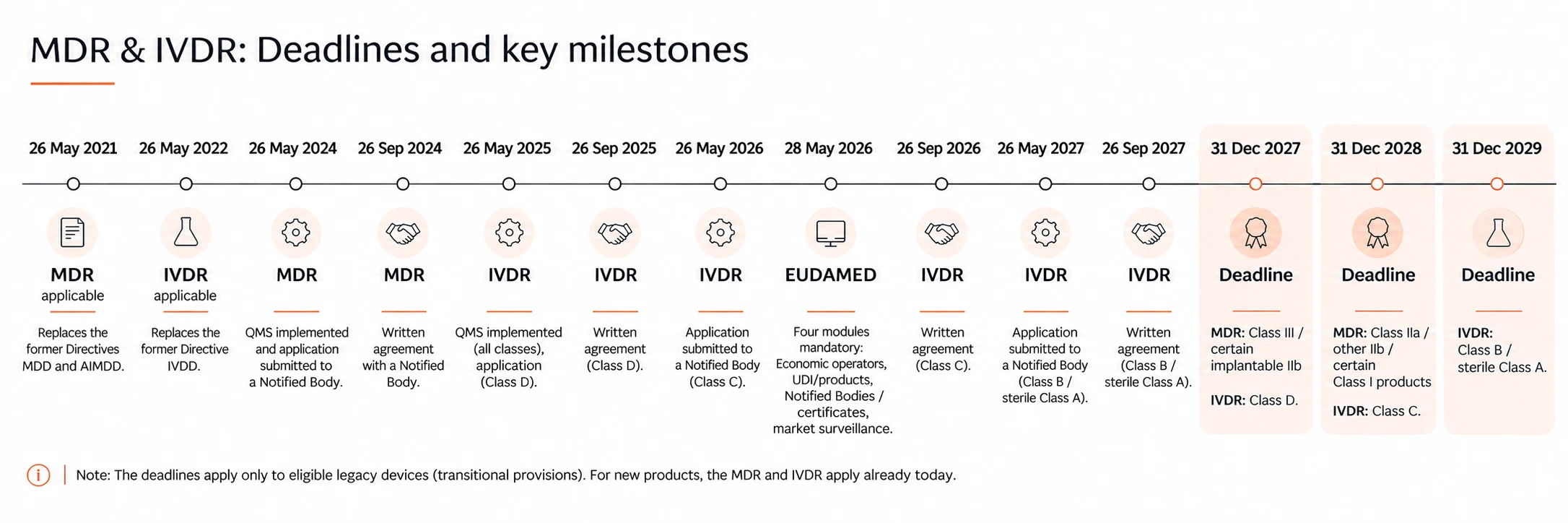
Regulation (EU) 2023/607 extended the transition periods for certain legacy devices.
| Product class | Transition deadline |
|---|---|
| Class I, standard | MDR applies since May 26, 2021 |
| Class I, requiring Notified Body involvement for the first time | December 31, 2028 |
| Class IIa | December 31, 2028 |
| Class IIb, certain non-implantable and exempted devices | December 31, 2028 |
| Class IIb, certain implantable devices | December 31, 2027 |
| Class III | December 31, 2027 |
Important: These extended deadlines apply only to devices that meet the conditions set out in Article 120 of the MDR.
Which requirements did manufacturers already need to meet?
- May 26, 2024: Establish an MDR-compliant quality management system and submit a formal application to a Notified Body.
- September 26, 2024: Conclude a written agreement with a Notified Body.
- Ongoing: Continue complying with the previous directives, make no significant changes to the device's design or intended purpose and ensure there is no unacceptable risk to health or safety.
Different provisions apply in certain special cases.
Manufacturers that do not meet the conditions for the transitional provisions cannot rely solely on the 2027 or 2028 deadlines.
4. IVDR: Which deadlines apply to in vitro diagnostic devices?
In vitro diagnostic medical devices are governed by a separate EU regulation, the IVDR (EU) 2017/746. It has applied since May 26, 2022.
The IVDR distinguishes between risk classes A, B, C and D.
| IVDR class | Transition deadline for eligible legacy devices |
|---|---|
| A, non-sterile | IVDR applies since May 26, 2022 |
| A, sterile | December 31, 2029 |
| B | December 31, 2029 |
| C | December 31, 2028 |
| D | December 31, 2027 |
December 31, 2027 also applies to devices covered by certain previous IVDD certificates.
Key IVDR application deadlines
- Class D: Application by May 26, 2025 and written agreement by September 26, 2025.
- Class C: Application by May 26, 2026 and written agreement by September 26, 2026.
- Class B and sterile Class A: Application by May 26, 2027 and written agreement by September 26, 2027.
To qualify for the extended transitional provisions, manufacturers were required to establish an IVDR-compliant quality management system by May 26, 2025.
These deadlines are based on Regulation (EU) 2024/1860.
5. EUDAMED: New mandatory registration requirements since May 2026
An important milestone is the phased introduction of mandatory use of the European database on medical devices, EUDAMED.
Since May 28, 2026, four modules have been mandatory (European Commission overview):
- Actor registration
- UDI and device registration
- Notified Bodies and certificates
- Market surveillance
For certain devices already placed on the market before that date, the deadline for retrospective registration is November 28, 2026.
Manufacturers should verify that their devices, certificates and company information have been registered completely and on time.
6. Which deadlines apply in Switzerland?
Switzerland has incorporated the main extended MDR and IVDR transition deadlines into its Medical Devices Ordinance (MedDO) and Ordinance on In Vitro Diagnostic Medical Devices (IvDO).
Additional Swiss requirements also apply, including those relating to economic operators, authorized representatives and device registration.
Device registration in the Swiss medical devices database, swissdamed, has been mandatory since July 1, 2026. A transition period until December 31, 2026 applies to affected devices.
Manufacturers and other affected economic operators should therefore review their registration obligations in good time.
7. MDR checklist: What should manufacturers review now?
The following questions are particularly important for manufacturers:
Has the medical device been assigned the correct risk class?
Is the device already fully compliant with the MDR or IVDR?
If transitional provisions are being used, can compliance with all applicable conditions be demonstrated?
Are the required supporting documents and agreements with a Notified Body in place?
Are the technical documentation, clinical evaluation or performance evaluation and risk management (ISO 14971) up to date?
Do the quality management system (ISO 13485) and post-market surveillance activities meet the applicable requirements?
Have the necessary registrations in EUDAMED or swissdamed been completed or scheduled within the applicable deadlines?
8. Conclusion: 2027 and 2028 are critical years
The MDR has been in effect for years. The extended transition periods give certain legacy devices additional time, but they do not eliminate the required conformity assessment procedures.
For many higher-risk medical devices, the transition period ends on December 31, 2027. Other device categories follow on December 31, 2028.
For in vitro diagnostic devices, certain transition periods extend through the end of 2029, provided the applicable conditions are met.
Manufacturers should therefore ensure well in advance that their conformity assessments, technical documentation and registrations meet the applicable requirements.
For more on what the MDR means for marketing and sales, read MDR and CE marking: What it means for your marketing strategy.
- Regulation (EU) 2017/745 on medical devices (MDR)
- Regulation (EU) 2017/746 on in vitro diagnostic medical devices (IVDR)
- Regulation (EU) 2023/607 (extension of MDR transition periods)
- Regulation (EU) 2024/1860 (EUDAMED and IVDR transition periods)
- European Commission decision on EUDAMED modules (Official Journal, November 27, 2025)
- EUDAMED and European Commission EUDAMED overview
- Swiss Medical Devices Ordinance (MedDO), SR 812.213
- Swiss Ordinance on In Vitro Diagnostic Medical Devices (IvDO), SR 812.219
- Swissmedic: Deadline for device registration in swissdamed
- ISO 13485:2016, Medical devices — Quality management systems
- ISO 14971:2019, Medical devices — Application of risk management to medical devices
Regulatory information as of November 13, 2026. This article is intended for general guidance. The applicable legislation and the classification of the individual device remain authoritative.
Published in November 2026